
How to Search the Hillsborough Court Docket
Hillsborough runs no municipal court search of its own. There is no city case database either. Every Hillsborough case is searched through the official North Carolina eCourts Portal. Choose Orange County, then look up a citation number, record number, or party name. The result is a Case Summary, sometimes called a Register of Actions. It lays out the public timeline of the case. From there you can read Case Events, Hearings, Dispositions, and any financial information. The public sees only what the record allows.
- Open Smart Search and select Orange County for the Hillsborough case.
- Enter the Hillsborough citation number, party name, or complete record number.
- Confirm case type, parties, court location, and case number before reading the timeline.
- Review public Case Events, Hearings, Dispositions, and financial entries in the Case Summary.
- Use Search Hearings and current Orange calendars to confirm the Hillsborough setting.
Sometimes the Portal is not enough. A thin result can be chased down at the Clerk's public terminal or through the paper-file route. Keep one limit in mind. The Portal offers public case lookup, but it is not the official court record, and it does not promise every document image or restricted case type.
Hillsborough Justice Center Clerk Access
Hillsborough is the county seat, so its main access point sits right in town. The Orange County Courthouse and Justice Center stands at 106 E. Margaret Lane. The Judicial Branch lists several functions at this Hillsborough courthouse. These include the Clerk, public terminal, paper-file, cashier, and court-contact functions. Call the main court number, 919-644-4500. Weekday hours run 8:30 a.m. to 5 p.m. Hillsborough matters go through this county core. There is no separate municipal court clerk. The official Orange County Courthouse page posts the location and visitor details straight from the court.
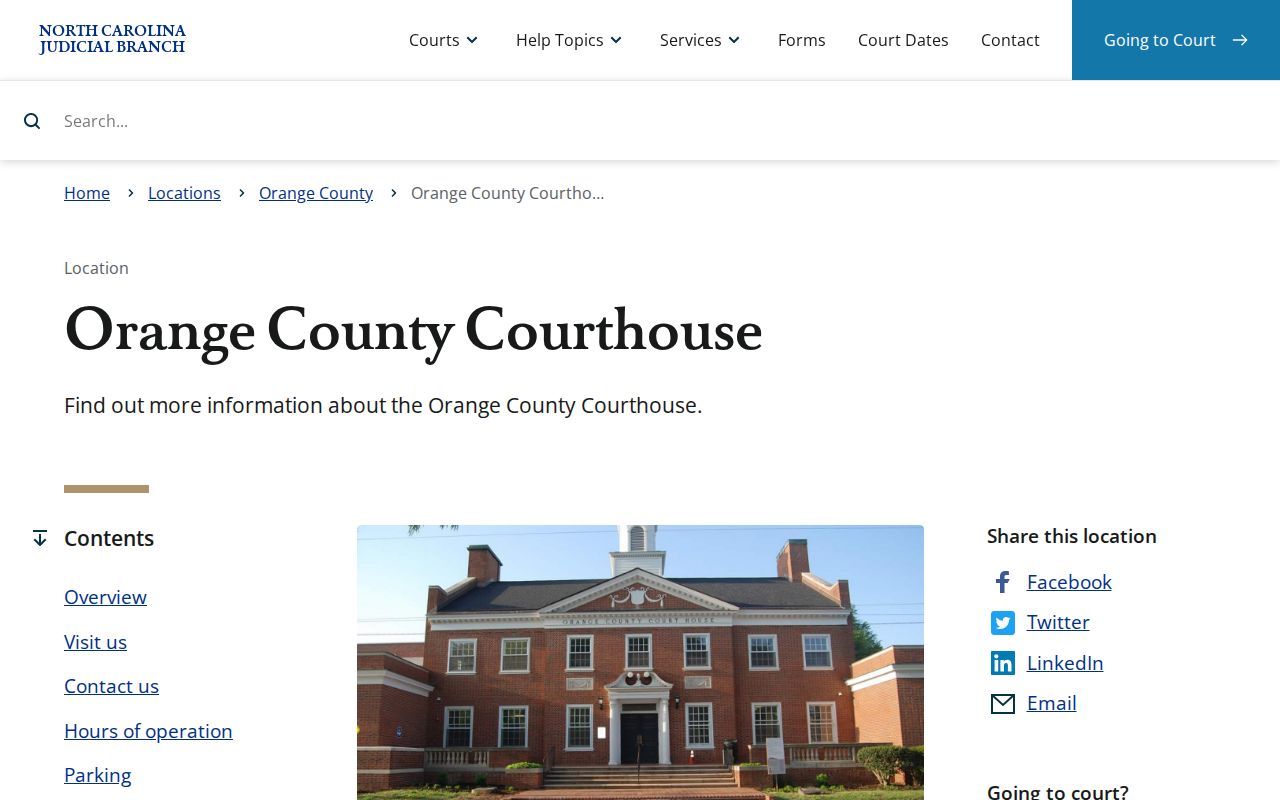
The Justice Center is the working clerk and court access point for a Hillsborough court docket. It is not a separate Hillsborough Municipal Court.
The Hillsborough Municipal Court
Hillsborough has no municipal court at all. No city docket database, municipal clerk court file, or city traffic portal exists. Instead, all Hillsborough court records flow through the Orange County state trial divisions. The Clerk of Superior Court keeps them. The structure is easy to see here because the county's central courthouse sits in town. Traffic tickets, infractions, and misdemeanors normally go to District Court. Felonies go to Superior Court. The Clerk keeps the records for both divisions. A case may start with a city address in its details. That origin never creates a standalone Hillsborough docket or changes who holds the official file.
Hillsborough access point: The county seat hosts the Orange court and Clerk functions. It does not operate an additional municipal court system for Hillsborough cases.
Hillsborough Has No Separate Court Search
Looking for a Hillsborough municipal-court portal leads nowhere useful. No city court search exists. The statewide Portal is the right tool. Select Orange County and work with the actual record details. That step serves both the online route and any later visit to the Hillsborough Justice Center. Smart Search accepts a party name, a citation, or a record number. For a Hillsborough infraction, the traffic citation number is often the fastest key. Searching by name takes more care. Check enough identifying case information to separate your Hillsborough matter from a similar statewide result. The county choice is the practical geographic filter.
Hillsborough Court Dates and Settings
Every Hillsborough court date is an Orange state-court setting. Search Hearings can locate current times and locations. You can query by case number, party, business, attorney, bar number, judicial officer, or courtroom. Cross-check what you find against Orange's local schedules, which post civil and criminal calendar links. Remember that a case can be reset or continued. A prior calendar date is never enough on its own.
| Case number | Connects the Hillsborough matter to the Orange court file. |
|---|---|
| Hearing date and time | Shows the current setting and should be confirmed near the event. |
| Courtroom or location | Identifies the state-court setting, which may be at the Hillsborough courthouse campus. |
| Judicial officer | Can be a public Search Hearings criterion for the Hillsborough case. |
| Setting type | Provides the procedural context for the hearing or calendar entry. |
Still stuck on a Hillsborough setting after the Portal and calendars? Call the Clerk, who can direct you to the right court channel. Court staff cannot give legal advice about the case.
Hillsborough Portal Then Clerk Terminal
Hillsborough access works best as a sequence. Begin with Portal Smart Search for public case details. Then use Search Hearings and the local calendars for a current setting. Need an official copy, a fuller public file, or an explanation of a restriction? Go to the Hillsborough Justice Center. Ask the Orange Clerk about the public self-service terminal or the paper-file location. State records guidance confirms that clerk offices keep these terminals for the public. The sequence matters because search and certification are different things. Portal Case Events may show that a Hillsborough order was entered. Only the Clerk issues an official copy. A terminal or paper file helps with older records too. Some are not fully available in the online public view. Bring the case number and a clear description of the document. For a pending matter, the same steps guard against relying on a stale setting. Search Hearings gives the current time and location. Orange's posted civil and criminal calendars add a local cross-check. Do the two sources disagree? Contact the Clerk or the right court channel before you appear. The docket is a living timeline. A printed date may no longer be the active one.
Hillsborough Traffic Tickets
A Hillsborough traffic ticket never becomes a city traffic-court matter. It belongs to the state District Court and the Clerk. Pick Orange County in the Portal for a docket search. Enter the citation number or another supported key. Then check Search Hearings for the current court date. The citation itself tells you whether to appear or waive. State Citation Services handles some cases online, though eligibility varies case by case.
The cashier window at the Hillsborough courthouse is one named Orange payment route. Convenience there has limits. It does not replace the Portal for hearing status or the Clerk for a court-record copy. Anyone contesting a non-waivable Hillsborough charge has two safe paths. Follow the live case sources for date and place. Or get legal advice.
Hillsborough Cashier and Court Record
Paying at the Hillsborough cashier window and pulling a court record are two different tasks. The Clerk of Orange and the Portal maintain the actual case file. A payment slip answers nothing about your hearing setting. It is not a certified copy either. Treat the cashier strictly as a payment channel for your docket matter.
| Hillsborough need | Best channel | What it provides |
|---|---|---|
| Current date or setting | Search Hearings and local calendar | Live hearing location and time information |
| Public case timeline | eCourts Portal Case Summary | Case Events, hearings, disposition, and applicable financial fields |
| Eligible payment | Hillsborough cashier or state route | Payment processing, not a records search |
| Official paper or certified copy | Orange Clerk | Original-file access or authentication as available |
Paying a Hillsborough traffic ticket by mail takes two items. Orange wants the citation signed and dated, plus a money order or certified check. Cash and personal checks are not accepted by mail. The full countywide procedure is spelled out in Orange County traffic court records.
Where Hillsborough Cases End Up
Hillsborough cases land in Orange County's state trial divisions. District Court takes the everyday matters: traffic, infractions, misdemeanors, family, and small claims. It also takes anything else within its jurisdiction. Superior Court handles Hillsborough felonies. It also takes civil cases above its stated threshold and appeals from District Court. The Clerk of Superior Court keeps the court records for both divisions.
Docket flow: Hillsborough citation, charge, or filing › Orange District Court or Superior Court › Orange Clerk and eCourts Case Summary
No municipal court sits in this path. The case type and the court assignment on the actual record tell you the division, and the Clerk provides the official route to the file.
Hillsborough Historic Court Campus Context
The Hillsborough court campus holds several named buildings. Treat none of them as interchangeable file counters. The county facility locator places the historic courthouse at 104 E. King Street. The courts annex sits at 112 N. Churton Street. The jail and magistrate office is at 125 Court Street. The District Attorney works from 144 E. Margaret Lane. Call the active docket counter the Justice Center or courthouse. Follow the Clerk's direction if it points you elsewhere. The Orange County facilities locator maps every one of these Hillsborough court-campus locations.
The map helps with orientation. It cannot tell you where a current court file lives. For any docket request, start with the Justice Center Clerk channel instead of guessing from a historic building name.
Hillsborough Justice Center Record History
County facility materials date the Hillsborough Justice Center to 2008. The historic courthouse stands apart in the local court landscape. That gap matters for older records. A historic courthouse does not automatically hold an older Hillsborough file at its storage or public counter. Ask the Orange Clerk where a requested record can be inspected or copied.
Courthouse visitor rules deserve a look before any Hillsborough record trip. The Judicial Branch posts free three-hour parking on East Margaret Lane. Bags and purses are not allowed inside the courthouse. Those access facts say nothing about a Hillsborough municipal court, because none appears in them.
Plan a record request around the active Clerk channel, not the nearest historic building. County documents describe the Clerk as maintaining court records and providing specialized storage. They never promise that a particular historic room holds an older file. Give the Clerk your case number and the record you need. It can then point you to the right current location.
The campus also holds the courts annex, the jail and magistrate office, and the District Attorney. Wait. Each serves a distinct public function. A Hillsborough docket search or copy request does not belong at one of those sites just because it is close by. Start with the Portal for public case information. Then use the Justice Center Clerk channel for a public terminal, file inquiry, certified copy, or payment question. That keeps the court record path tied to the office that maintains it.
Public Access to Hillsborough Court Records
Hillsborough court records run through the Orange Clerk and public state-court channels. North Carolina law and court restrictions still apply. The Portal exposes publicly available information. The Hillsborough Clerk terminal and paper-file path still serve public records where appropriate. Juvenile, sealed, expunged, confidential, and protected material may not appear in a public Hillsborough search at all.
Key Rules for Hillsborough records:
N.C.G.S. § 7A-109 requires clerks to maintain court records, files, dockets, and indexes and allows public inspection except where law restricts it.
N.C.G.S. § 132-1 defines public records, while other statutes and court orders can limit access.
N.C.G.S. § 132-1.10 permits removal of listed sensitive identifiers from public court images and copies.
For an official Hillsborough document, hand the Orange Clerk three things: the case number, the county, and the record you want. A thin Portal result calls for a clerk access question. It is not a conclusion about why public information is missing.
Hillsborough's courthouse cluster makes in-person access practical. It does not erase statutory limits. The Clerk can identify a public file and the available copy route, but it cannot hand over material made confidential by law or court order. Bring the exact number, party name, and document description for a focused request. That keeps a public Case Summary from being mistaken for an authenticated court document.